Thursday, February 09, 2006

Inventory Management: A Way to Give It a Grade - Knowledge@Wharton


Inventory Management: A Way to Give It a Grade - Knowledge@Wharton: "'The most sophisticated companies in supply chain management realize that responsiveness in inventory management is important.'"

Interesting article on Inventory management in today's Knowledge@Wharton -- the sentence above pretty much sums up the findings. The article's main focus in how an operational issue like inventory management impacts the stock price. However it suggests that because increasing inventory turns doesn't seem to impact stock price it is not important.

Actually my experience tells me something slightly different - you need both Responsiveness AND efficiency. Our company has helped clients increase customer service levels and increase inventory turns. We have done this enough times so that I believe most companies do not operate anywhere near their potential. That is they under-serve their customers carry too much inventory in the wrong places. For those of you with a financial background - they are not operating at the efficient frontier of their business.

For example
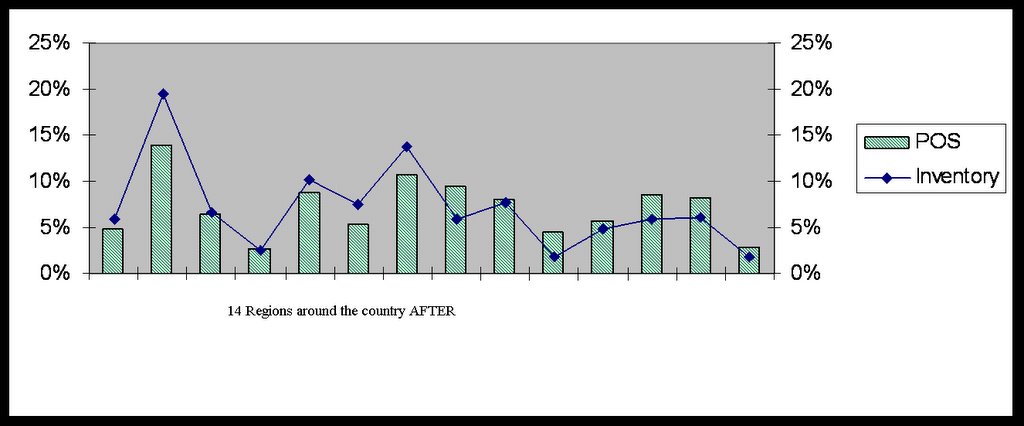
Examine the 2 graphics at the top of the column. We helped a manufacturer selling to a large well known retailer. The retailer did the forecasting at a category level and sent purchase orders to the manufacturer every week. In the first picture - you can see the misalignment between sales and inventory. In some places sales where very high but there was not enough inventory, in other place the opposite was true. In their standard process this happened EVERY week. The weeks of supply of inventory was anywhere between 17 and 80 weeks for this category.

In the second graphic shows the measurements AFTER our process was executed. The process includes examining the promotions, Point of Sale (POS) , competitive sales, current inventory positions and manufacturing process. We have been doing this weekly now for 20 weeks and have been able to keep the inventory to 3 weeks +/- 1 week - note this is been steady thru the holiday and more importantly post holiday.

Even the high end of this range - 4 weeks, we are turning inventory 13 times AND the retailers measurement of instock went from 60% to 90+ %! What if you took your highest revenue category and used this type of process - how much capital could you free up AND how much more revenue are you missing. (Our client found that with better instock postions their revenue and their retailers revenue went UP)

Next time I will tell you how we did it and no it was not with RFID

Tuesday, December 27, 2005

Scary Smart Christmas Gifts

Check out 20q.net -- my kids each received one of the handhelds from their aunt. The thing is amazingly smart -- even when I thought of relatively abstract things it came close. The web site is even smarter....


Monday, December 26, 2005

Successforce Blog: How to Improve your Professional Services Organization

A self referential link to some of the tools I've discussed in the past.

OpenAirand Salesforce works quite well independently - but combined you get the added benefit of a master data management, MDM infrastructure - at least for a small company. A larger company (>$50 M) would probably need a separate system to manage those data.

A good MDM process ensures you consistently use the same names for customers, shipping addresses, products, etc. Sounds silly but simply cleaning up your data sets and keeping them that way can help you serve your customers much better (and cheaper). A inordinate amount of time can be wasted trying to to get everyone communicating the same message across the company (engineering, support, professional services, executives, sales). In a small company this can be a matter of life and death.

Fundamentally a good MDM process supports communication across the organization silos that exist in many (most) companies for a certain size (over 10 or so).

Never underestimate the effectiveness of simple clear communication to improve your business.

Friday, December 23, 2005

Best ecard I've seen! www. jacquielawson.com

The last few days I have done Christmas cards "with" my wife. That is she wrote out the messages on a few and I updated the mail lists, did the mail merged, stamped and addressed all the cards.

All the while thinking of how this could be done better -- I'd like a web based SaaS site where I could upload my addresses, have the addresses checked and updated, design new cards and then mail them. I know the last part is an anarchronism - but until now it was always more a pain in the butt to read an ecard plus there are many of my relatives that never look at their email.

A day after I slogged thru that task, I received a card from this site. This is almost exactly what I'm looking for -- maybe next year.

Sunday, December 11, 2005

RFID status

Well after 3 years of doing RFID worldwide and seeing valuable and wasteful RFID projects in 13 countries -- here's a couple of quick lessons for finding value.

1. Mandates - they are negotiable! Comply with the standard GTIN/SSCC but limit number of SKUs and limit geography. Also Go to your favorite tag vendor and get them preprogrammed and slap them on! (Or better yet push your cardboard supplier to embed them - a few years out most likely)
(For this phase - do not buy software/readers! and minimize tags)

2. Experiment in a small area (requires readers and software)

Characteristics of a valuable RFID deployment
- usually has high value items
- might include correlation to other data (temperature, humidity, vibration, etc)
- changes behaviour at the edges of your supply chains. I've seen multiple world class retailers deploy RFID and the best area of value is in store ops! (aka change your process)
- Re-use the tags!
- Measure value prop for the new business processes.
If it doesn't make sense -- see Item 1 above -- then minimize costs

Readers
-- Check your vendors roadmaps, there is much innovation out there (like temp. tags at 915 MHz) that you should take advantage of if it makes sense.

Software
-- start with middleware independent of WMS/ERP. Work the process (experient, understand, bring in other parts of your org to strategize). Then later buy what you need.

RFID is a game changing technology for those that use it right - unfortunately most people I've seen just comply with the mandates EXPENSIVELY instead of exploring how to leverage the technology into business value.

Monday, April 25, 2005

Value II -- Use less RFID tags!

OK - so you've "checked" your customers compliance box but you think you can't expand because tags are so expensive - now what?

First realize that you've gained some knowledge (regarding RFID) and now have another tool to address your standard supply chain issues. Combining your new expertise with mathematical techniques like statistical sampling will allow you to quickly identify key problem areas in your supply chain.

For example - is your CFO wondering why there is so much working capital invested in inventory in your business? If you can quantify your desired (or required) customer service level and then using RFID start to measure where your products go and how long they stay there, you can start to identify areas for improvement.

For example - one customer of mine discovered that while the "touch" time to create and ship a pallet was a mere four hours; the average time was ten days and the longest time was over sixty days! We collected thousands of data points and plotted a histogram with the x axis being "days" and the y-axis being number of cases. (For those of you familiar with a bell curve - imagine a bell curve with a large lump far to the right). Given that a pallet of goods represented a large amount of money, having an extra 30 or 40 pallets hanging around and NOT knowing it is not a good thing. In this instance the customer was tagging every case and every pallet to meet a mandate. HOWEVER, the same thing could be learned for non mandate SKUS for much less investment.

By tagging a fraction of the cases/pallets , the company could have characterized that same "bell curve with a lump". Instead of tagging thousands of cases, they could have tagged hundreds with only 1/10th the cost. By identifying (and removing) that "lump" the company can now save a few hundred thousand dollars in working capital AND had more room in the warehouse . In addition - now the company can monitor the SKU in real-time and drive that average time frame closer to the "4 hour touch time" from the 10 day average time, saving many more dollars of working capital in the process. Your CFO may even buy you lunch.

I've obviously skipped over the details - but by combining some relatively simple things

1. RFID tags, readers + middleware
2. statistical sampling
3. A bit of process work

you can build yourselve a continuous improvement engine that will more than pay for your RFID tags and might even get you a bonus.

Sunday, April 24, 2005

How to get value from RFID

Your company may have already complied with the Walmart, Target and other mandates. Now the question is - how does YOUR company get an ROI from RFID?

There is obviously value in doing business with those retailers and in being a "good" partner. However, you still have to make your boss, your CFO and shareholders a return on investment, you can not add costs to the business.

First, consider that like other technology RFID is just a tool. Tools are neither good nor bad by themselves (or expensive or cheap), they only get that way based on how they are used.

For example, many companies are just doing "slap and ship" to comply with a mandate or two. No data collection, no analysis, no thought process on how to improve just PURE COST. In this case RFID would be very expensive, particularly for low margin items.

However, for a company that is committed to delivering continuous improvement quarter after quarter there are ways to get value from RFID. Ignore the hype and start by thinking creatively about YOUR business. Look for areas where you are having trouble (late deliveries, missed shipments, poor supply, too much inventory, etc.) I'm sure there are "unresolved opportunities" in your supply chain --- especially around the boundaries between organizations.
If you can't find any -- ask your boss. She will be glad to tell you exactly where to look.

Boundaries are the best place to look since handoffs occur between two parties, either you and your customer or internal to your organization. Once a handoff occurs and if your cases/pallets are "fungible" (no unique id's) then it is very difficult to determine the source of the problems.

For example, one company had experienced significant growth in the past year and had trouble delivering the "perfect order" to their customer (A large demanding UK retailer). The necessary infrastructure growth (an additional plant), supply chain changes (new 3PLs) and unique challenges (meet a ferry) made it difficult to determine the root cause of the problem. Worse yet, because each plant was fairly well run as was the 3PL, the source of the problem would vary between various constraints; plant 1; plant 2; logistics provider; ferry etc.

By using RFID to track the orders (pallet and truck level) to that one retailer -- they are able to
1. Determine the root cause of the issue for latter improvement
2. Resolve the issue BEFORE the customer ever gets the order.

This client does not have a mandate yet, but they will probably be notified regarding a mandate soon so they get the additional benefit of being one of the leading suppliers for their customer. If a low margin food company can be successful using RFID - what problems can you solve?

Monday, April 11, 2005

RFID Value

You need to be a subscriber - but the key take away is that Hampton Products International got value from RFID by just tagging items. Hampton is not an OAT customer but they describe having NO DEDUCTIONS on RFID tagged products. This is the holy grail of Retail and CPG vendors - the "perfect order". Note 3 OAT customers have also documented the same result. RFID is delivering value to both CPG and Retail customers. This is key for the industry!

Friday, April 08, 2005

Tools I use -- putting in systems at a startup

Part of setting up a company is to work on the hiring (people), processes and systems. One of the biggest challenges I have is staffing projects in a nacent industry like RFID. To address this challenge - I've taken the typical consultant approach and worked on the people, process and systems issues. I'll post on the people and processes later, but here are a few of the systems I've deployed as OAT as grown. I'm currently running the Services and Support functions at OATSystems. We use a couple of tools that are fantastic in my opinion. As an implementer, developer and manager of software tools for the past two decades, I enjoy seeing good products that deliver value. ( I own no stock in these companies.)

First is a tool for Professional Services Automation (PSA) that I can manage the schedules/expenses/timesheets of people in 4 countries (US, India, UK and China ).
This hosted tool allows me to keep a rolling 6 month forecast on a daily basis. I've been in many different companies over the years and very few companies are able to achieve this level of accuracy, consistently in their forecasts. We do have our issues now and again, but at least now we know when they are coming. Maintaining the data is about 3 hrs per week and except quarterly reporting there's little else to do but run the weekly reports for our CFO. This model allows us to run services pretty tight with a very good Sales & Operations planning process (S&OP)with the sales team. The company is OpenAir , they also have a great services and support team. I would strongly recommend this to anyone running a large (more then 20) team of professionals and are trying to make money while improving customer service.

We use RightNow for our customer support tool. Support is also great there -- and there CEO has been known to call in to check how things are going. (Disclosure: they are another Greylock funded company). We've started measuring ourselves based on these data and the customer surveys -- an excellent data set for improving customer service.

We also use salesforce which I just use as a feed to OpenAir but the sales folks are starting to embrace it pretty well. There seems to be quite a community growing around salesforce and expect them to become a "platform" vendor of choice for sales management. I know we can get more from this product but a lack of bandwidth and our current understanding limits us.

(All examples of a good Software As a Service SaaS model)

RFID - The last few years

For almost 3 years, I've been working in various roles for OATSystems in Massachusetts, USA on RFID software projects. See www.oatsystems.com.

We started as a small consultancy helping Gillette, MIT and others deploying the first EPC/RFID systems and have envolved into a midsize (100 person) company with worldwide deployments.

I've watched the industry mature from hardware/software that didn't work and took an extraordinary amount of effort to deploy, to something that is fairly straightforward (at least for us)and is starting to provide useful results to businesses.

It is quite exciting to see customers eyes light up when they start to understand what can be done with the data. Being able to watch in real-time what your supply chain is doing is going to allow re-architecting of many businesses. The next steps are going to be even more fun - imagine adding "rules" on top of your business that you can monitor and -- gasp -- optimize in real-time. This goes far beyond what we dreamed possible while I was at i2.

Obviously the industry has quite a few challenges to overcome first -- such as gen2 compliant architectures and lower tag costs. plus the education of a few hundred companies. The burning question in my mind -- Can you remove significant costs/radically change your offering with new processes, RFID + other sensors? If not , can your competitors? My bet is that someone is going to do this soon....

Software as a Service - Part 1

Software as a Service - Part 1: "
I can’t tell you how many board meetings I’ve been in lately where the agenda included a discussion of the merits of software-as-a-service as a potential business for the company. The one thing that is constant about these discussions...
"

Jeff nails it again -- after 20 years of building decision support systems, it is clearly evident to me that SaaS is something "whose time has come". I've seen a recurring pattern in my career, where once the software is implemented and the team leaves -- interest in the project starts to wane and it become part of the normal day to day business. That means all the care and feeding necessary to keep a application delivering value goes away and with it, the value disappears. SaaS fixes the incentives for everyone -- so that

1. The customer continues to get value
- let's face it, lock in from having proprietary systems is going away -- lockin is only achievable by continually delivering value

2. The software company aligns cash flow to execution rather than large upfront payments and then a smaller revenue stream. Thus behaviour across the company is aligned to maintain and grow that revenue stream. Last company I worked - the biggest deals actually were bad for the company, since once they were sold, the company had higher expectations to meet and everyone ran off for the next deal, rather than execute the deal we had just sold.

There are obviously many concerns with SaaS that Jeff touches upon but I think this will be good for the industry as the current model is busted in my opinion.

Friday, December 24, 2004


Backyard view on a Dec morning Posted by Hello

Merry Christmas

The children (3) have just gone to bed (waiting for Santa). Of course, they are too old to believe in Santa -- but then again they are waiting up for him. Perhaps they are just good scientists; I hope they figure out it is a wee bit hard to prove a negative.

My wife is stuffing their stockings with gifts from Santa, one they figure out how to google their dad - then the gig is up. I suspect it will take them a couple of years to find this blog. But then again - there is stuff out there I wrote in 1990 so I suspect this will be cached on some server in 2014.

Historical note - my grandfather John Chadwick kept a journal from 1928 or so thru 1980's -- I'm working thru his early college years currently. He was very poor, had little to eat but seemed to enjoy himself considering everything. Hard to compare to my current situation (blogging!) on wireless networks and traveling like crazy. My biggest problem (like most American's it seems) is eating too much -- compare that to a college student in the late 1920's or even to a soldier in Iraq.
BTW - there is no mention of a "depression" in his journals - I guess once you are poor, you don't notice that suddenly many others have also become poor.


Tuesday, December 21, 2004

Been awhile -- (14 months!) Nothing like a startup to keep you busy. Team is now built, no longer about just consulting but we have product, positioning and the competition is heating up.

RFID is a wild space, when we started it was just us picking up the phone and doing good work for clients - now any software company who can spell "RFID" has a solution. We are still ahead given the size of our deployments -- everyone else will have to climb this curve and it is very steep. A few will fall (a couple of companies have been acquired / merged ) and you can actually see them fail to execute due to the internal focus. Even the big guys are having trouble, they may have 10k people but only a very very few can make RFID work and the "market-tectures" are flying fast and furious.

While watching our startup grow in people and revenue I'm also comparing to the other VC companies -- a couple of good blogs are www.feld.com and www.jeffnolan.com


Sunday, October 19, 2003

Ok - the world it changing again and I've not figured it out. However there's a feeling things are getting crazy again.

Examples:
1) Tivo - I like TV (very strange but now I never surf nor watch live TV or commercials)

2) Vonage - been using it a few weeks - works great and very cheap. www.vonage.com

3) Work is getting busy and its hard to hire people with the correct skill set in Boston (supply chain, XML, Java, OOD)